Guitar Theory Basics
basics
- The Staff
Single Staff
Double Staff - Clefs
G Cleff - Treble Clef
F Clef - Bass Cleff - Sharps and Flats, Double Flats, Accidentals
- Notes & Rests
- Dotted Notes & Rests
- Key Signatures
- Time Signatures
The Staff
Types of Staves
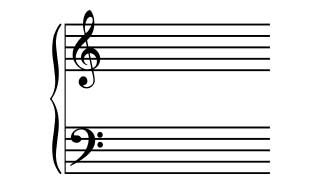
Single Staff: For one line of music notation
Double Staves: For two lines of music notation usually top staff for treble clef and bottom staff for bass clef. (Grand Staff)
All standard music notation and markings will be written on the staff, or somewhere near it. This includes Notes, Clefs, Time signatures, Key signatures, Dynamics, Navigational cues.
Clefs
Clefs
There are several types of Clef symbols. We will be using the treble cleff for guitar notation.
Treble Clef:

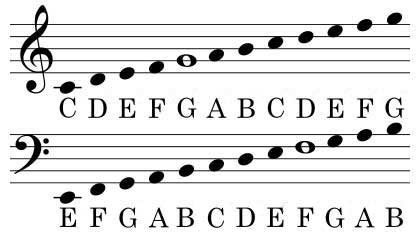
The treble clef (G clef) tells you where the note G is located on the staff, on the second line from the bottom of the staff.
The bass clef is used for bass for example bass guitar or left hand on piano.
Bass Clef:

The bass clef (F clef) tells you where the note F is located on the staff, on the fourth line from the bottom of the staff.
The bass clef picks up where the treble clef ends. On a piano it's called middle C
The bass clef picks up where the treble clef ends. On a piano it's called middle C
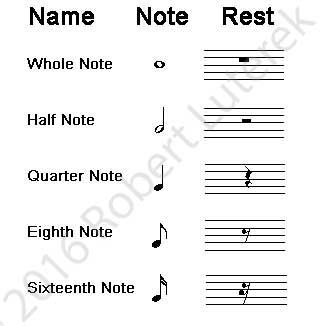
Notes and rests
Sharps and flats raise or lower a note by a half, or even a full, step. They define the key in the key signatures and can appear in notation on the staf next to notes on the staff to disignate a singal note sharp or flat called accidentals.
Sharps are used to raise a specific note by one half step and are always written on the line or space of the note they raise.
Flats are used to lower a specific note by one half step and are always written on the line or space of the note they lower.
Double flats and double sharps are used to lower a specific note by one whole step and are always written on the line or space of the note they lower or raise.
Accidental is a sharp or flat that is not in the key signature but appears next to a note. Accidentals only last until the end of the measure or through tied notes across a measure.

Sharps, Flats, Double Sharps, Double Flats, Accidentals, Natural
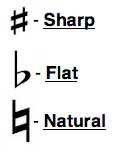
Sharps and flats raise or lower a note by a half, or even a full, step. They define the key in the key signatures and can appear in notation on the staf next to notes on the staff to disignate a singal note sharp or flat called accidentals.
When we add a Sharp or Flat to a note it raises or lowers the note by a Half-step. For example, if we have the note A and we add a sharp to it the note now becomes A-sharp. If we have the note D and we add a flat to it the note now becomes D-flat.
Sharps are used to raise a specific note by one half step and are always written on the line or space of the note they raise.
Flats are used to lower a specific note by one half step and are always written on the line or space of the note they lower.
Double flats and double sharps are used to lower a specific note by one whole step and are always written on the line or space of the note they lower or raise.
Accidental is a sharp or flat that is not in the key signature but appears next to a note. Accidentals only last until the end of the measure or through tied notes across a measure.
Naturals are notes that are not played sharp or a flat even if the key signature calls for it,, you would play the natural note. For example a Ab, adding the natural sign means to play a A instead.
Dotted Notes and Dotted Rests
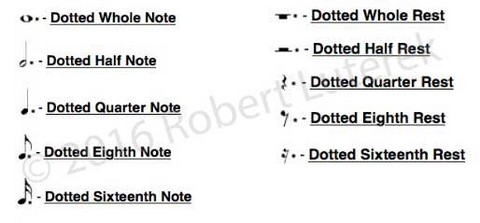
Dotted Notes: If you were playing a dotted half note you would play the two beats of the half note, and then add half of the amount of time of the half note. The dotted half note would last three beats. You play the two beats of the half note, and then add one more beat giving you three beats.
Dotted Rests: This is also applied to rests. If you have a dotted half rest, you will rest for three beats, the two beats of the half rest, and then add half of that two beats giving you another beat for a total of three beats of silence.
Key Signatures
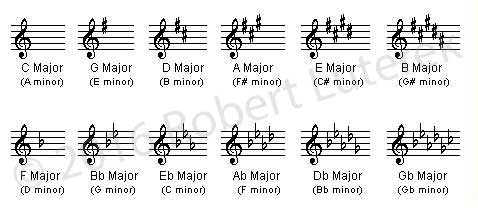
Key Signatures
Key signatures indicate the key of the song by telling you how many sharps or flats there are.
Every key has it's own signature and is determined by the number of flats or sharps shown.
Every key has it's own signature and is determined by the number of flats or sharps shown.
Sharps and flats appear in the key signature in the same order in which they appear the circle of fifths.
Time Signatures
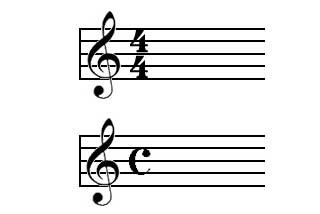
Time Signatures
The time signature gives you information on how many beats are in a measure and which note value gets the beat.
The top number represents the number of beats in a measure and the bottom number is which note value gets the beat.
For instance 4/4 time has 4 beats in a measure and 1/4 note gets the beat with four quarter notes per measure.
Common Time Signatures:
2/4 = Two quarter notes per measure, quarter note gets the beat.
3/4 = Three quarter notes per measure, quarter note gets the beat.
4/4 = Four quarter notes per measure, quarter note gets the beat.
5/4 = Five quarters notes per measure, quarter note gets the beat.
3/4 = Three quarter notes per measure, quarter note gets the beat.
4/4 = Four quarter notes per measure, quarter note gets the beat.
5/4 = Five quarters notes per measure, quarter note gets the beat.
Sometimes a C is where a 4/4 time signature goes. This means “common time” and is still 4/4.